Getting Your Trophy Home from Canada
The hunt ends when your bull is on the wall and your freezer is full. Here's exactly how we handle trophy care, meat, and the paperwork between the field and your front door.
You hunted hard for this. Maybe it's a 300-inch 6x6 management bull, maybe it's one of those Saskatchewan whitetail giants with all the mass in the world, maybe it's the non-typical you've been picturing since you booked. Whatever it is, the animal's down, and now comes the part a lot of guys quietly worry about: getting it home in one piece, legal, and without turning your last day in camp into a paperwork headache. Here's the honest answer. You don't do much of any of it. That's the whole point of hunting a private, family-run ranch that's been at this for 30-plus years. We handle the heavy lifting so you can keep doing the thing you came here to do.
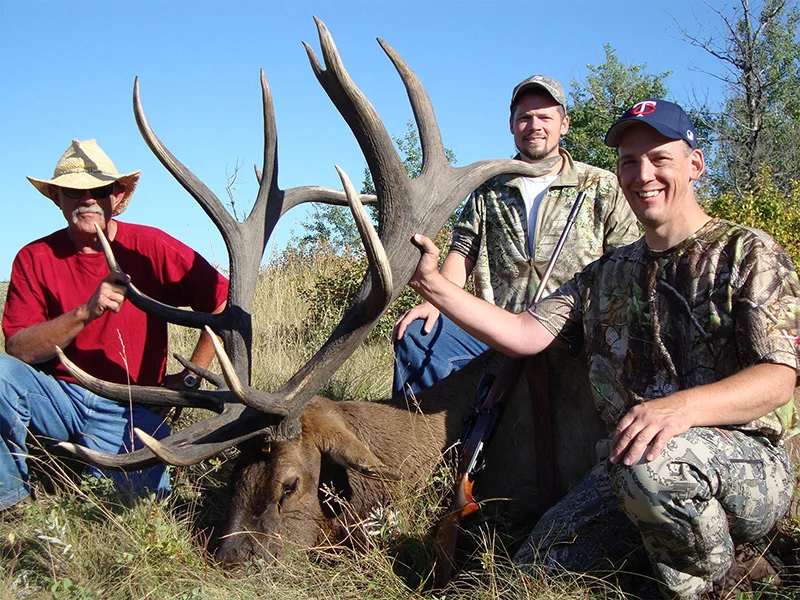
First things first when an animal goes down: photos. Before anything else, before we so much as touch a leg to load it, we get your photos. This is your hunt, your trophy, and you only get that moment once. We take our time, we get the light right, we get the angles right, and we make sure you've got the pictures you'll actually want to show people back home. A whitetail in the buck brush or a big northern bull out on a grass meadow with the river hills behind him photographs a whole lot better than a tailgate. So we do it properly, in the field, while everything still looks the way it did when you squeezed the trigger.
Once the photos are done, the guides take over. These are men who've spent 20-plus years on this exact land, so loading and recovering an animal off a cutline or out of the thick poplar is routine for them, not an adventure. They get it loaded and they bring it back to the barn, where the real trophy care happens. And this is where Dunhams does something a little different. You're welcome to come watch the whole process from the man cave in the barn. Grab a beer, kick back, and watch your animal get handled right while you replay the stalk. There's no rule that says trophy care has to be cold and clinical out behind a shed somewhere. We'd rather you be part of it, warm, with a drink in your hand.
Caping and freezing are included. That's not an upsell, it's just how we do it. Your cape comes off the right way by people who've done it thousands of times, because a botched cape can ruin a mount no matter how good the taxidermist is. It gets handled and frozen so it holds until it's ready to travel. The same goes for the antlers or horns. Done in-house, done correctly, included in what you already paid. You don't lift a finger and you don't pay a nickel extra for the care that protects the trophy you worked for.
Now, getting antlers and capes out of Canada and back to the States or wherever home is, that's where the rules get real. There's export documentation involved, the CITES-type paperwork that has to be done correctly or your trophy gets hung up at a border. We don't wing this. We work with trusted exporters who handle the antlers and capes and the export side of things day in and day out. That's their whole business. We guide you through the paperwork on our end and hand off to the people who do this professionally, so it gets done right the first time. You won't be standing in some office trying to decipher a customs form on the morning of your flight. We've run this play more times than we can count.
Then there's the meat, and this is one a lot of hunters don't think about until they're standing there with a 900-pound elk and a return flight to catch. We offer an optional deboning service for $250. The crew debones the animal and packages the meat so it's ready to travel, whether that's packed into coolers for the drive or set up to fly home as checked baggage. On a northern bull that can run anywhere from 700 to 1,200 pounds on the hoof, deboning isn't a luxury, it's the difference between bringing your meat home and leaving most of it behind. For 250 bucks it's some of the best money you'll spend on the trip, and it saves you the guesswork of trying to figure out air-travel weight limits with a quarter on a bathroom scale.
All of this is easier because you knew what was coming before you ever left home. Every hunter gets a pre-trip packet, and it's not fluff. It's got your travel details laid out, the gear list so you pack right, and for U.S. hunters, the firearm import forms you'll need to bring your rifle across. Fill those out ahead of time and the border is a non-event. One thing to be clear on, because people ask: in Canada there's no airport pickup and no jet or chopper to the lodge. You fly into Edmonton or Saskatoon, both about two and a half hours out, rent a vehicle, and drive in. The packet tells you exactly how, so there are no surprises on arrival day.
On the gear front, layer up. A moisture-wicking base, a wool or fleece mid-layer, a quiet windproof shell, waterproof insulated boots you've already broken in, a couple pairs of gloves, and a warm hat. The packing list spells it all out. Dress for the parkland and prairie, not for sitting still in a stand all morning being cold and miserable.
The bottom line is simple. From the second the animal hits the ground, you've got people who've been doing this for decades taking it from there. Photos, recovery, caping, freezing, export through trusted hands, optional deboning packaged for the trip home. Your only job is to hunt. If you've got questions about any of it before you book, call us at 780-871-1747 and we'll walk you through exactly how your trophy gets from a Saskatchewan meadow to your wall.