How No Kill, No Pay Works
No draws, no tags, no luck. We're a private ranch, and if you don't kill, you don't pay. Here's why we can put that in writing when almost nobody else will.
Let's start with the part everybody asks about first: if you don't kill, you don't pay. That's not a slogan we printed on a hat. It's in writing, it's been our deal for more than thirty years, and we mean it the way it sounds. You come up, you hunt, and if for whatever reason you don't put your hands on an animal, you don't owe us for the hunt. Most outfits can't say that and stay in business. We can, and the reason is simple once you understand how this place works.
The reason a real one-hundred-percent guarantee is even possible comes down to one thing: this is private, high-fence land. Dunhams High Caliber Ranch sits in Saskatchewan and Alberta near Lloydminster, along the North Saskatchewan River valley — pine and poplar forest, open grass meadows, river hills, and cutlines. We're one of the oldest and largest private hunting ranches in Canada, family-run, and we've been at it for over thirty years. Because it's our ground, there are no draws and no tags to wait on. No lottery. You book this season, you hunt this season. Compare that to a public draw where a guy puts in for years, builds points, and still might never pull the tag for the unit he actually wants. Here you pick up the phone and you're hunting this fall.
That's the difference between hoping and going. A lot of hunters spend a decade chasing preference points for one good elk unit somewhere, and the math never quite breaks their way. We took the gamble out of it. The animals are here, the access is here, and the only thing standing between you and the hunt is the calendar. And the calendar matters, because we keep the numbers low on purpose — but more on that in a minute.
Now, the guarantee only works because of the people running the hunt. Our guides have twenty-plus years on this exact land. Not twenty years guiding somewhere — twenty years on these properties. That kind of time means a guy knows which way the wind swirls in a given coulee at first light, where the cutlines funnel deer and elk when they're moving, and how a herd bull behaves when the rut turns on. He knows what a cold front does to animal movement, and he can read when the cows start cycling and the bulls lose their minds over it. That's not something you fake or learn from a book. It's earned by being out there every season for two decades, and it's the single biggest reason we can promise what we promise. Our cooks and lodge staff have been with us fifteen-plus years too, so the whole operation runs like people who've done it a thousand times, because they have.
It helps that the men in charge are owners, not booking agents handing you off to a stranger. Rob Dunham is a professional hunter and guide who's spent a lifetime building this, and North American Whitetail called him a pioneer in whitetail outfitting in Canada. His son Josh runs the operation alongside him. When you hunt here, you're hunting with the people whose name is on the gate. That's a different level of accountability than an outfit that subcontracts the whole thing out.
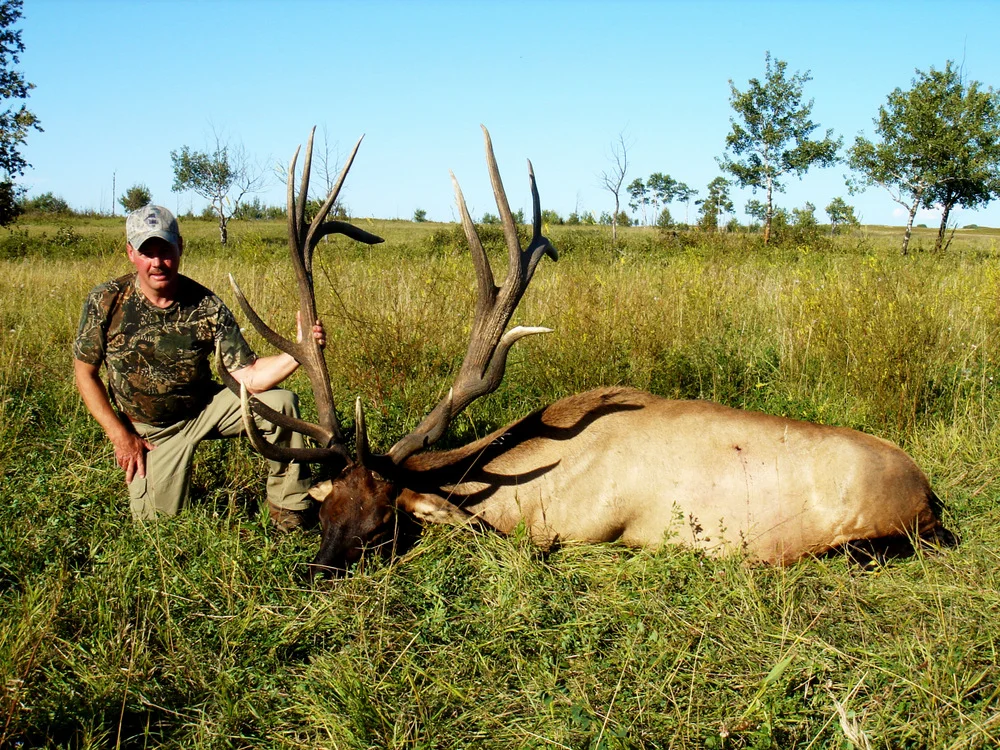
The other half of the equation is herd management, and this is where a lot of folks get the wrong idea about a private ranch. We don't just turn animals loose and hope. We manage the herd carefully so the genetics and age structure stay where they should be. On the elk side that means Rocky Mountain elk with big northern bodies — bulls running 1,000+ pounds — and a range that starts at a respectable 300-inch 6x6 management bull and climbs all the way up to non-typical giants over 500 inches. The biggest we've ever taken went 628. On whitetail, we're talking genuine Saskatchewan giants, mature four- and five-year-old deer carrying real mass, roughly the 160- to 300-inch class. Those numbers don't happen by accident. They happen because somebody is paying attention to the herd every single year.
Part of managing it right is keeping the hunts limited. Our elk availability is limited to mature trophies dependent on the breeding program, and historically we run around 55 whitetail. That's it. Once the calendar fills, it closes. We do that for two reasons. One, it protects the resource, so the quality stays where it is instead of getting hammered down. Two — and this is the part hunters feel out in the field — low pressure means the animals behave naturally. They aren't bumped and educated and running scared by week two. A bull will still bugle back. A buck will still work a scrape line in daylight. When animals act like animals instead of spooked targets, the hunting is better and the guarantee is a whole lot easier to back up.
The elk rut is September into October, and it sells out a year ahead, so that one you plan for. The rut is also the best time for archery if that's your game — there's nothing like calling a bull in close when he's fired up and the cows are cycling. If you'd rather reach out with a rifle, that works too. We'll confirm your zero at the range before you ever hunt so there are no questions when the moment comes.
As for how you actually hunt, we run it two ways and we'll match it to you honestly. If you're fit and you want to earn it, we'll put you on a hard walk-and-stalk — glassing, slipping through the bush and the river hills, playing the wind, closing the distance on your own boots. If your knees or your lungs aren't up for that, or you just don't want to grind it out, we've got truck and ATV access that puts you in good country without the long miles. Neither one is the lesser hunt. They're just two honest ways to get it done, and there's no shame in picking the one that fits your body. We'd rather you tell us straight so we can put you where you'll succeed.
When you do connect, the trophy care is handled. Photos come first — you'll want those and we'll take the time to do them right. Then the guides load the animal and process it back at the barn, and you're welcome to watch the whole thing from the man cave in the barn with a cold one. Caping and freezing are included, trusted exporters handle the antlers and capes, and if you want your meat deboned for the trip home, that's an optional service. We're not going to leave you standing in a field wondering what happens next.
On logistics, a little straight talk saves everybody grief. You fly into Edmonton or Saskatoon, both about two and a half hours from the lodge, rent a vehicle, and drive in. There's no airport pickup and no jet or chopper to the door up here — that's not how Canada works for us, and anybody promising it is blowing smoke. Arrival day you check in around eleven, have lunch, confirm your rifle at the range, and then get out for a half-day hunt that same afternoon. Hot lunch gets served out in a field tent so you're not burning daylight driving back. Beer and wine are included in moderation, and if you want spirits you can grab them in Lloydminster. Before you come, we send a pre-trip packet with travel details, the firearm import forms for U.S. hunters, and a full gear list. Dress in layers — a moisture-wicking base, a wool or fleece mid, a quiet windproof shell, waterproof insulated boots you've already broken in, a couple pairs of gloves, and a warm hat. Northern weather doesn't care about your plans.
So that's how no kill, no pay actually works. Private land takes the draw out of it. Twenty-plus-year guides who know the wind and the rut take the guesswork out of it. Careful herd management and strictly limited hunts keep the animals where they should be and behaving the way they should. Put all of that together and a real written guarantee stops being a gamble and starts being a reasonable promise. The only thing we can't control is the calendar, and it fills every year — the rut especially books a year out. If you've been sitting on draw points waiting for a maybe, quit waiting. Give us a call at 780-871-1747 and let's get you on the books for this season.